



Minnesota Nice Isn’t Gone—It Just Looks Different Now
How educators and communities are responding to ICE activity in Minnesota schools.
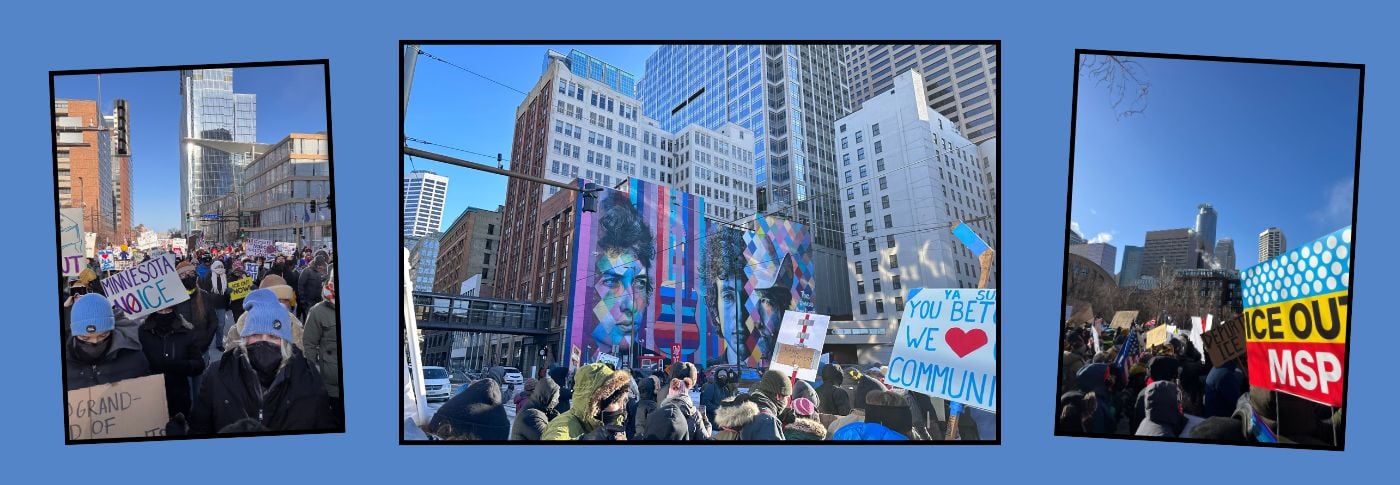
Scenes from protests against ICE in downtown Minneapolis. Photo credit: Andy Kratochvil and Mary Cathryn Ricker
Share
February 20, 2026
How educators and communities are responding to ICE activity in Minnesota schools.
Share
Over the past months, Immigration and Customs Enforcement (ICE) activity in Minneapolis and St. Paul has disrupted schools, frightened families, and mobilized educators across Minnesota. Federal immigration enforcement operations near school buildings have kept thousands of students home and forced communities to organize quickly. I traveled to Minnesota to listen, to witness, and to understand what was happening on the ground.
On a Saturday morning not long ago, I sat in my hotel room watching the news in disbelief as yet another person was shot and murdered in Minnesota, only two weeks after Renee Good was killed in Minneapolis. Alex Pretti, a nurse who cared for veterans, was tackled by multiple ICE officers and shot on the street during what authorities described as an “immigration enforcement action.”
I’ve been at a loss for words. I feel anger, sadness, helplessness and frustration. As I watched the crowds grow and the skies fill with smoke, possibly tear or pepper spray launched on video by ICE agents, the news captured an older man with gray hair just screaming into the smoke, yelling, “I’m just angry. I’m 70 years old and I’m f__’ing angry.” His raw emotions broke me. It spoke directly to how I was feeling: an overwhelming desire to scream, to be present, to say loudly: This is not OK.
For many families in Minnesota’s immigrant communities, these immigration enforcement actions have not been isolated incidents. They have become part of daily life.
I am from Minnesota.
You know the state of you betcha, doncha know, and uff dah. The state of Minnesota Nice. If you’ve ever been at a four-way stop with four Minnesota drivers, you’ve experienced it: a traffic jam as everyone politely gestures for someone else to go first.
This is the state where a goodbye takes not minutes, but hours. The “OK, thanks for having me” turns into multiple conversations in the living room, then a slow walk to the door with hugs, then more conversation on the porch, then another round at the car. My kids, who are growing up in Northern Virginia, go absolutely nuts. Mom. It is time to GO.
Or dinner at my aunt’s house: Do you want something more? No, I’m good. Are you sure? Yes. No, really, you should have some more. Eventually, I say yes just to make it stop. My husband cannot comprehend this. He cannot understand why, when someone says no, you keep asking. Because in Minnesota, the offer is the point. The care is the point.
Cold? You think cold stops Minnesotans? Go watch someone drill a hole in a frozen lake and sit there for hours.
That instinct to show up for one another is part of what people call Minnesota Nice. Right now, it’s being tested by aggressive immigration enforcement across the Twin Cities.
I want to be honest with you about something: What is happening in Minnesota right now is far worse than what the national news headlines capture.
I know, because I spent a week there. I flew in to learn from educators, union leaders, parents, and community members who have been living this for weeks. And what I found rattled me in ways I am still processing.
I found a city under occupation. That’s not hyperbole; that’s the word multiple people I spoke with used themselves, without flinching.
I found a school district of 33,000 students—70 percent Black, brown and Indigenous, with nearly a third receiving English language services, and where between 6,000 and 7,000 children had stopped going to school in person. Not because of snow (as if snow would stop school in Minnesota), but because their families were terrified.
Teachers and parents described ICE vehicles circling school buildings with cameras out the windows, filming who came and went. Agents staged in school parking lots. Special education support vans with students inside were pulled over, and drivers were questioned. Families were being picked up from workplaces, meaning a child would arrive home from school to find no one there.
This level of immigration enforcement near Minnesota schools has created fear far beyond what most national coverage conveys.
Families were directed to complete a Delegation of Parental Authority (DOPA), a legal form that designates who can take custody of a child if a parent is detained and does not come home. The form has existed for years. What changed is that communities could not afford to ignore it.
Local unions organized DOPA clinics, shared quietly, by word of mouth, never by registration list, and sent notaries and attorneys directly to families to get the paperwork done.
Constitutional observers—trained community members—show up when ICE activity is reported. Phones out, they document what happens in real time.
A parent volunteer and teacher I spoke with described colleagues at her school, people here legally, working through asylum cases, who went to a recent routine immigration check-in and returned to work wearing ankle monitors.
“When they went for just a standard check-in,” she told me, “they came back to work with them on.” She paused. “Some people aren’t coming back at all.”
One of the most powerful things I witnessed in Minnesota was something you won’t see in most news coverage: ordinary people standing witness during immigration enforcement operations.
Constitutional observers, trained community members, show up when ICE is reported, phones out, documenting everything. They have become one of the most consistent and effective tools in the community's response.
Their role is simple but critical: document, record, and ensure that no one disappears without a witness.
Using the SALUTE method—Size, Activity, Location, Uniform, Time, Equipment—observers create structured, legally useful records of every encounter. Their presence can change behavior; when agents know they are being watched and filmed, they are more likely to follow established procedures. But not always.
What observation guarantees is that there is a record and that no one disappears without a witness.
SALUTE is a structured documentation method used by constitutional observers to record law enforcement activity. It stands for:
Observers use the SALUTE method to create clear, legally useful records of immigration enforcement encounters.
In Minneapolis, St. Paul, and the surrounding suburbs, these observers have become as essential to the community response as the mutual aid networks and school patrols.
My window into that world was Emily, my childhood next-door neighbor.
We grew up on the same street in Shoreview, Minnesota, in the same grade, sprinting home from the school bus together every afternoon to watch DuckTales and catch the opening theme song and sing and dance to "DuckTales, woo-oo!" We loved the movie Clue so much that we can both still quote from it to this day.

Neither of us would have predicted then, sitting on that street in Shoreview, that she'd end up on the New Brighton City Council and I'd end up on a school board in Virginia. We certainly wouldn't have predicted that what would finally bring us back together, after years of lost touch, would be this. She called it what it is: a war zone.
When I pulled up and saw Emily for the first time in years, I got out of the car and hugged her. Before we even got in her car to start observation, she said, "I had a very scary encounter with ICE yesterday. They boxed me in."
The day before, Emily had dropped her son off at school and checked her Signal chats to see where she was needed. Driving home, she spotted an ICE vehicle outside someone's house. She pulled over and watched. She sat there for nearly half an hour, observing. When the ICE vehicle moved, she followed it to a parking lot and pulled over to keep an eye on the vehicle and the ICE agent.
Then more ICE vehicles arrived, and it got scary.
One pulled in on one side of her. Another on the other. A third behind her. And the person she was observing positioned their vehicle in front of hers, boxing her in.
They took her picture. They waved at her. They circled her car in their vehicles and taunted her. Her community dispatcher had to get off the call, and there was no one in the area who could assist her. And then everything went still—just Emily, alone in the parking lot, surrounded by four vehicles of federal agents. She eventually put her car into drive and slowly tried to edge out of the circling vehicles, hoping they would let her go.
"It takes a lot for me to get kind of shaken," she told me. "And that one did it."
After it was over, she drove to her parents' house and switched cars. Her plate had been photographed. She knew they had it now. So, she took her dad's car.
And then she went back out.
Not because it is normal. But because survival requires you to treat it that way.
When I said, "And you're back out today," she shrugged. "Here we are. You know, I mean, you just do it."
This is a city council member and a University of Minnesota employee. A girl I grew up with on a quiet street in Shoreview. Someone who still knows every line from Clue. And right now, this is what her community needs from her.
And then there was the moment that has stayed with me most.
I was talking with an elementary school teacher and member of the Saint Paul Federation of Educators, someone who has spent weeks delivering groceries and rent for her students and families too afraid to leave their homes. She was telling me, almost matter-of-factly, about a rent delivery the night before. She knocked quietly on a dark house—lights off, curtains drawn. Inside, she knew, were roughly a dozen people, staying silent, keeping still, waiting.
This is what safety looks like for some families in Minnesota right now: a dark house, a held breath, a knock at the door from someone you hope you can trust.
What struck me wasn’t the story. It was how she told it: calmly, as one item in a long list of things that had happened that week.
It had become normal.
Not because it is normal.
But because survival requires you to treat it that way.
I caught myself, sitting across from her, feeling the weight of what it means to witness something that has become routine for someone else. That gap—between how horrifying this felt to me as someone arriving from outside and how matter-of-fact it had become for people who have been living it for weeks—might be the most important thing I can tell you.
And yet, what I witnessed was a community that took everything that makes Minnesota the state we love—the checking in, the showing up, the stubborn insistence on caring for the person in front of you—and turned it into something formidable.
Parent patrols at bus stops and during school arrival and dismissal. Grocery delivery networks. Rent checks handed through darkened doorways. Volunteer site captains at 70 school buildings. Mutual aid funds. A union-led Deportation Defense Committee that had begun organizing a full year before the immigration enforcement crisis escalated, so that when it did, they weren’t starting from scratch.
One leader reflected on what it has meant to see her neighbors rise up: “There is no going back. You see people differently now.”
That Minnesota Nice instinct to check one more time—no, really, are you sure you don’t need anything?—turns out to be exactly the muscle you need when your community is in crisis.
I went to Minnesota to learn. What I found was something I already knew but had forgotten to name: that the kindness people sometimes dismiss as quaint is actually a form of radical care. And right now, in Minnesota, radical care is the work.
This is the first in a series of posts about what I saw, what I learned, and what I believe the rest of us need to start doing before we find ourselves building the plane while we’re already flying it.
CARE stands for Community Awareness, Readiness, and Education. This community is a space for educators, union leaders, families, and community partners to find tools, examples, and reference materials that support awareness, preparedness, and care when immigration enforcement actions or other moments of uncertainty may affect our schools and neighborhoods.


